
The Four Marketing Problems That Keep Businesses Stuck
WAIT!!! BEFORE YOU START READING…
Join 4,000+ others boosting their business and balancing their life. You'll get actionable tips to leverage content marketing, simplify conversion, and master productivity. (Plus get access to additional resources, guides and training, immediately.)

These are not four stages every business moves through in order. They are four different levers.
The goal is to identify which lever is most likely to improve the result right now.
The mistake is assuming every marketing problem should be solved by creating another post.
Lever One: More Marketing
At the first lever, the business simply needs to create more.
People cannot remember a business they rarely hear from. They cannot understand an offer that has only been explained once. They cannot consume content that does not exist.
A lot of businesses are under-marketing. They send an email when they launch something, post when inspiration strikes, and record a video whenever the lighting is good, their hair cooperates, and Mercury is not in retrograde.
Then they wonder why the market has not developed a clear understanding of what they do.
The problem is that “do more marketing” is still too vague.
More could mean publishing seven times a day or finally sending the email you have been rewriting since February.
A business needs a floor.
I call it the 1-3-1 Marketing Floor:
One macro piece. Three micro pieces. One email. Every week.
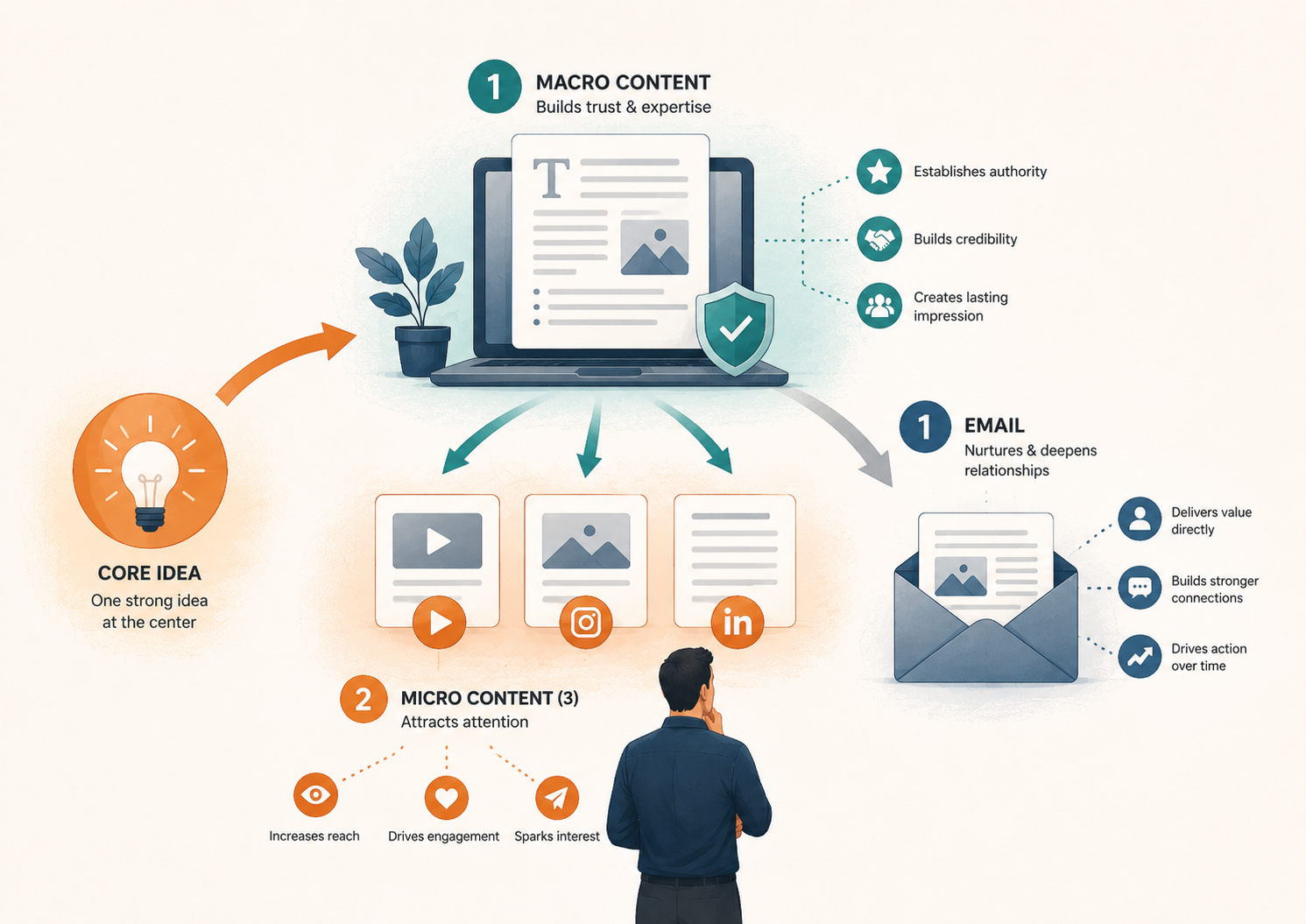
The reason for that mix comes from what I call the Triple-A Approach to marketing:
Attention. Affinity. Authority.
Micro content creates more opportunities for attention. Short posts, clips, observations, and ideas make it easier for people to discover you.
Macro content builds affinity and demonstrates authority. Articles, videos, and podcast episodes give people enough time with your thinking to understand your point of view, develop trust, and see that you know what you are talking about.
Most businesses lean too far in one direction.
Some create only macro content. They produce thoughtful articles, long videos, or podcast episodes, but too few people ever discover them.
Others create only micro content. They post constantly and may even get views, but the audience never spends enough time with their ideas to understand who they are or why they should trust them.
The 1-3-1 Marketing Floor solves both problems.
The macro piece fully develops one worthwhile idea. The three micro pieces pull out its strongest observations, examples, or lessons. The email puts the idea directly in front of people who have already asked to hear from you — the one channel you actually control.
You do not need five unrelated ideas every week.
You need one good idea, developed with enough depth to matter and expressed often enough to be noticed.
Over a year, that produces 52 macro pieces, 156 micro pieces, and 52 emails.
Look at the last eight weeks.
Did you create eight macro pieces, 24 micro pieces, and eight emails?
If not, your first marketing problem may not be your positioning, funnel, branding, or the algorithm.
You may simply be below the floor.
Even if you are already at the floor, more marketing can still be the right lever.
If the marketing is working and you have the capacity to increase output, creating more may produce more opportunities for attention, engagement, leads, and sales.
At this lever, the solution really is more.
The problem starts when you create consistently, but every useful idea gets published once and abandoned.
Every article has the life expectancy of a fruit fly.
Every video is uploaded, receives 112 views, and gets buried beneath the next video.
That is no longer a production problem.
It is a distribution problem.
Lever Two: More Distribution
More distribution means getting more mileage from the marketing you have already created.
An article should not have one job, in one place, on one day.
It can be used during sales follow-up, shared with referral partners, sent directly to someone who would benefit from it, promoted with advertising, linked to from other content, and brought back months later when most people have forgotten they ever saw it.
But “repurpose your content” is not much of a strategy.
It is one of those pieces of advice that sounds useful until you sit down on Monday morning and have to decide what to actually do.
A simpler way to think about distribution is this:
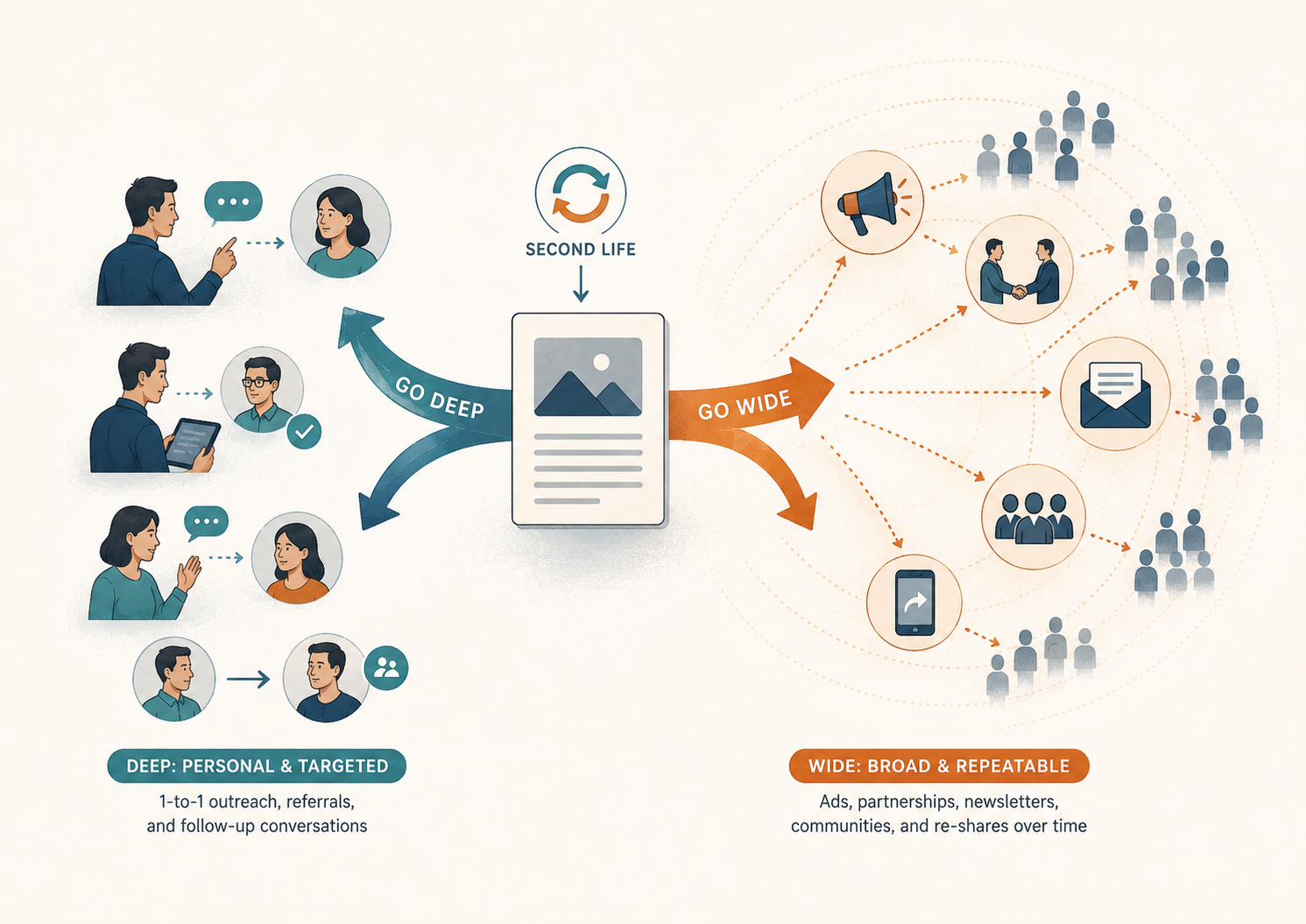
Go deep and wide.
Go Deep
Going deep means deliberately putting the marketing in front of specific people who should see it.
Do not publish an article and hope the right person wanders into it.
Choose ten people.
Send it directly to a client, prospect, referral partner, colleague, or subscriber who has already expressed interest in the problem the article addresses.
Do not send a mass-produced message pretending to be personal. Give them a reason you thought of them.
You might write:
“I remembered our conversation about getting more mileage from your content. I just wrote this and thought you might find it useful.”
That is distribution.
You can also use the article during sales follow-up. Send it after a conversation when it answers a question, supports a recommendation, or explains an idea better than you could in another twelve-paragraph email.
Share it with referral partners who regularly encounter the problem you wrote about. Add it to your onboarding. Link to it when the same question comes up again.
Going deep means treating marketing as a useful asset you can place into conversations, not merely something you publish into the feed.
Go Wide
Going wide means increasing the number of opportunities for people to discover the idea.
Put a small advertising budget behind it when the subject is closely connected to the problem your buyers are already trying to solve.
You do not need to spend thousands of dollars. Even $20 or $50 can help a useful idea travel farther.
Share it through a partner who already reaches the audience you want.
Send it to a podcast host whose listeners would care about the subject.
Offer it to a newsletter, association, or community that serves the same market.
Bring it back in 30, 60, or 90 days.
The internet has trained business owners to behave as though anything published more than six hours ago is an ancient artifact recently uncovered near the Dead Sea.
Your audience does not remember your content nearly as well as you do.
Most of them did not see it the first time. The people who saw it may not have needed it then. The people who needed it may have been distracted by a meeting, a child, a text message, or a video of a raccoon stealing cat food.
Sometimes your marketing is not failing.
It simply has not been distributed enough.
Before creating something new, take one useful piece you have already created and give it another life.
Send it directly to ten people.
Put a small budget behind it.
Share it through someone else’s audience.
Use it in a conversation.
Bring it back later.
Lever One gets the idea published.
Lever Two keeps it from disappearing.
Of course, increased distribution can also reveal an uncomfortable truth.
People are seeing the marketing.
They just do not care.
That brings us to the third lever.
Lever Three: Better Marketing
At this point, publishing more will not solve the problem. Neither will putting more money behind it.
More distribution cannot rescue marketing nobody finds useful, relevant, or interesting. It only gives more people the opportunity to ignore it.
The business needs better marketing.
Better marketing does not necessarily mean prettier graphics, more expensive cameras, or a logo that spins when the website loads.
It usually means clearer thinking.
A simple way to improve the marketing is to strengthen three things:
The problem. The point. The proof.

The Problem
Weak marketing usually starts with a problem that is too broad.
It talks about wanting more growth, more freedom, better results, stronger leadership, or improved marketing.
Those may all be real desires, but they are too vague to make someone stop and think, “That is exactly what is happening to me.”
Better marketing identifies the problem more precisely.
“Your marketing is not working” is broad.
“You publish every week, but each idea disappears after one post” is specific.
The clearer the problem, the easier it is for the right person to recognize themselves in the message.
The Point
Better marketing also makes an actual point.
A lot of content identifies a problem and then repeats advice the audience has already heard.
Be consistent.
Know your audience.
Provide value.
Work smarter, not harder.
None of that is necessarily wrong. It is simply too familiar to be memorable.
A strong piece of marketing gives the audience a useful way to think about the problem.
The point of this article is not merely that businesses should improve their marketing.
The point is that there are four different marketing problems, and creating more only solves one of them.
That is a point someone can understand, remember, and apply.
The Proof
Then the marketing needs proof.
Proof does not always require a formal case study or a spreadsheet filled with percentages.
It can be an example, a client result, a demonstration, a comparison, a story, or a piece of reasoning that makes the point difficult to dismiss.
If you say most businesses waste their content, show what that looks like.
If you say a different approach works better, explain why.
If you say you can produce a result, give the audience a reason to believe you.
Without proof, marketing becomes a collection of confident statements written by the person who benefits most if they are believed.
Take a piece of marketing that did not perform well and ask three questions:
Is the problem specific enough for the right person to recognize?
Does the piece make a clear point, or does it repeat familiar advice?
Is there enough proof to make the point believable?
Then revise those three things.
You do not always need a new topic, a new campaign, or a new content calendar.
Sometimes you need to make the existing idea sharper.
The problem should feel familiar.
The point should feel useful.
The proof should make it believable.
That is better marketing.
Once the marketing works, the next opportunity may be to build more ways for it to reach people.
That is Lever Four.
Lever Four: Better Distribution
Better distribution means building more ways for your marketing to reach people.
At this lever, the business is already creating consistently, getting more mileage from its ideas, and improving the quality of the marketing itself.
Now it is time to expand the distribution.
That usually means three things:
Add platforms. Add channels. Increase the budget.
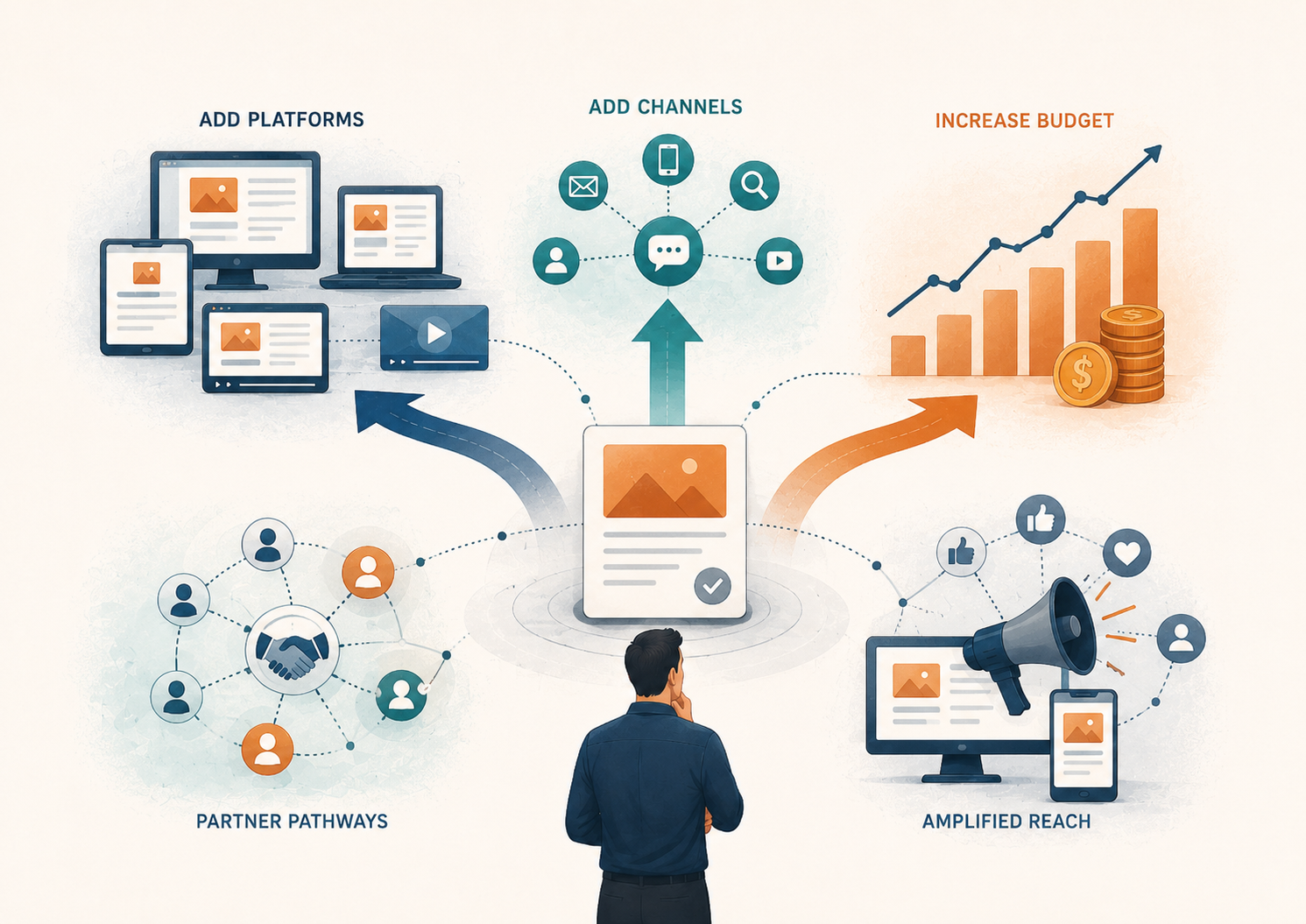
Adding platforms means taking ideas that are already working and bringing them to another place.
You might add YouTube to an article and email strategy.
You might expand short-form content from one platform to two.
You might turn a podcast into video, clips, articles, and email.
The goal is not to be everywhere.
The goal is to create more places where people can find you.
Adding channels means finding new ways for the marketing to travel.
That could include partnerships, podcasts, newsletters, referral relationships, events, communities, affiliates, or other businesses that already reach the people you want to reach.
You are no longer relying only on your own audience or your own platforms.
Increasing the budget means putting more money behind the marketing that is already producing attention, leads, or sales.
At Lever Two, you might spend a small amount to give a useful piece of content more reach.
At Lever Four, paid distribution becomes a larger and more deliberate part of the system.
You increase the budget behind the messages, content, and offers that have already shown signs of working.
Better distribution is not about being everywhere or spending money on everything.
It is about expanding the reach of marketing that has earned a larger audience.
Add platforms.
Add channels.
Increase the budget.
That is better distribution.
Diagnose the Actual Problem
The value of these four levers is not that one is always better than another.
The value is knowing which problem you are trying to solve.
If you are below the 1-3-1 Marketing Floor, or you have the capacity to create more, start with more marketing.
If you create consistently but each piece disappears after publication, you need more distribution.
If people see the marketing but do not care, respond, or remember it, improve the problem, point, and proof.
If the marketing works but its reach is limited, add platforms, add channels, and increase the budget.
A business can also need a different lever in each area. A strong email list and an abandoned YouTube channel is not one problem. It is two, and they need different levers.
The goal is not to graduate from one lever and never return. The goal is to identify the current constraint.
Most businesses never do that. They stay on the content treadmill because creating something new feels productive — the same instinct behind the Crazed Plate Spinner. There is always another post to publish, another email to send, another video to record, another platform waiting.
But the goal is not to build the largest possible pile of marketing.
The goal is to create something worth seeing, get it seen, improve it based on the response, and build more ways for it to reach people.
Ready to Fix What Is Keeping Your Marketing Stuck?
Knowing which marketing problem you have is useful.
Fixing it is better.
If you want direct help identifying the constraint, choosing the right lever, and building a practical plan around your business, apply for one-to-one coaching.
Not ready for that level of support?
Join Captain’s Log for practical marketing ideas, strategies, and prompts you can use to keep moving.